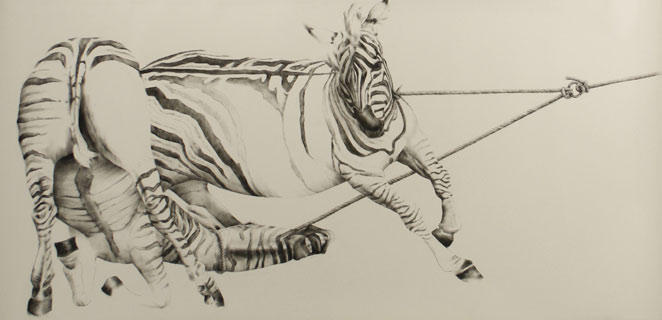
Untitled (zebras) 2006
charcoal on paper
Julie Comnick
Yesterday I dropped by Julie Comnick’s new show at the Flashpoint Gallery in DC (Jan 4 – Feb 9). I say “dropped by” because, despite her obvious technical skill, my attention was fully engaged for only about five minutes. It’s a solid show, but it didn’t provoke me to the kind of reconsideration & reflection I demand from art on a scientific theme.
Here’s the press release:
In According To Their Kind, Julie Comnick’s exhibition of large-scale charcoal drawings, the artist explores issues of selective breeding and the human impact on the course of evolution. The installation at the Gallery at Flashpoint is comprised of five distinct series of drawings: quotations from the story of Noah’s Ark, depictions of animals paired and bound for breeding, tethered boats (arks), excerpts from modern reproductive medicine and magnifications of in vitro fertilization procedures. The juxtaposition of these images asks the viewer to consider several unsettling trends in contemporary society. While animals are selectively bred in captivity to revitalize endangered populations, humans are able to pre-select the genetic makeup of their children.
Did you catch all that? This show was, despite the small exhibition space, really five shows in one. All of the pieces are “untitled,” and they were so disparate it was difficult for me to take in the entire show as curated.
The grouping that flows best is the series of thirteen small framed drawings depicting the stages of an embryo created by in vitro fertilization. The broad strokes of charcoal suited this series remarkably well. That really is how an embryo looks through a light microscope: black and white, smudgy and grainy, against a stark white field. The careless tumbling of the round embryo from corner to corner of the field throughout the series of drawings successfully conveyed both the unpredictable randomness of development – will this embryo implant, or fail? – and a sort of playful geometric abstraction. I think they’re lovely, and at only $250 apiece, quite the steal.
However, Comnick seems intent on pushing not just the aesthetics of the embryo, but the ethics of it. And here’s where things get messier. The embryo drawings alternate with oversized reproductions of passages from various fertility manuals (example: “Third Party Reproduction: A Guide for Patients“) or the Bible, and with still larger renderings of zoo animals being bred in captivity. The effect of these juxtapositions, to me, was confusing. What, aside from human agency, is the common thread here?
Juxtaposing the passages about Noah’s ark with the portraits of endangered animals makes sense, perhaps, since the population of endangered animals in captivity comprises a sort of genetic ark; but these animals were being bred in the traditional way, not through IVF or biotechnology. I’m hardly an expert, but the restraints and tethers appeared similar to those used to breed common domesticated animals, such as horses; there was nothing exotic going on – except that once you mix restraints, including blindfolds, with apparently unwilling participants – and in the drawing of the lions, a snapping whip – you enter rather fraught territory. The animals were by no means anthropomorphized, but the context forced certain comparisons between human and animal reproduction that I’m not sure were intended!
Looking at these images, are we supposed to be disturbed by the violence of the breeding methods? Are we supposed to make the obvious connection to human reproduction? It seemed so to me. What relevance might such a visceral response have to evaluating our stance on biotechnologies like IVF? Would a response informed by these emotions be a valid entry to reconsidering a controversial subject, or a mere gut reaction? I think it’s relatively simple to create art depicting unfamiliar and disturbing aspects of biology – the science which is, after all, most intimate with sex and death. It’s harder to turn the unfamiliar and disturbing into something new, something that implies an unexpected conclusion, or asks a pointed question. Time and again I see art related to biotechnology which doesn’t ask intelligent, well-formulated questions. Perhaps it’s because I’m a biologist, but I don’t think a tossed salad of controversial ideas – IVF, evolution, extinction, selection, sex, religion – creates an effective debate in the mind of the viewer.
The gallery press release suggests that the pieces are united by the impact of human agency on evolution. But is that accurate? Given the rarity of IVF, it seems unlikely to alter human evolution. One of the reproduced passages describes selecting sperm in order to predispose the gender of the embryo one way or the other, and it’s true that egg donors are often chosen for superficial characteristics (we’ve all seen the ads in campus newspapers offering thousands of dollars for the ova of tall, blond, athletic overachievers). But IVF as currently practiced is by no means going to shift the human phenotypic norm towards blond overachievers. Even if you fear human reproduction might eventually reach a Gattaca-like state of draconian genetic selection, that’s a different scenario than last-ditch efforts to sustain endangered species. We’re not endangered; that’s not why we do IVF. And revitalized populations of zebras and lions would, ideally, show a minimal phenotypic stamp of our interference; that’s the point. We’re trying to counter genetic bottlenecks caused by our species – not caused by natural selection. Breeding dogs or horses to phenotypic extremes seems a more apt analogy for the Gattaca scenario. I could go on, but my point is that these are such complex and disparate issues, interleaving them seems artificially simplistic, and maybe a bit inflammatory.
I suppose one could argue that many gallery-goers never think about IVF or evolution or the ethics of selective breeding, so a show like this at least jars them into considering science in a new context. But is that good? Isn’t the linkage of IVF with a struggling pair of breeding zebras a strange linkage to plant? I certainly don’t expect art to be educational, easy, or explicit. . . so perhaps my expectations of this show are unfair. Comnick has the right to create whatever associations she wishes, and she owes no explanation to me. Yet as a scientist, I prefer shows that provoke the public to ask coherent questions – not leap to associations that may or may not be representative of the real science. And somehow I can’t go into a gallery and pretend I’m not a scientist. That may well be my failing, not Comnick’s.
Ah well. Funnily enough, the most disconcerting aspect of the entire show for me was the inclusion, among all the biological, sexual imagery, of boats. Sailing boats. Yes, I suppose they’re arks, and they’re tethered, and they’re paired – but come on! Although I have the utmost respect for the technical skills of the artist (how does one execute a drawing 100 inches tall without wrinkling the paper or smudging the charcoal?) I’d like a little less of it next time, please.
7 Responses to According to their kind?